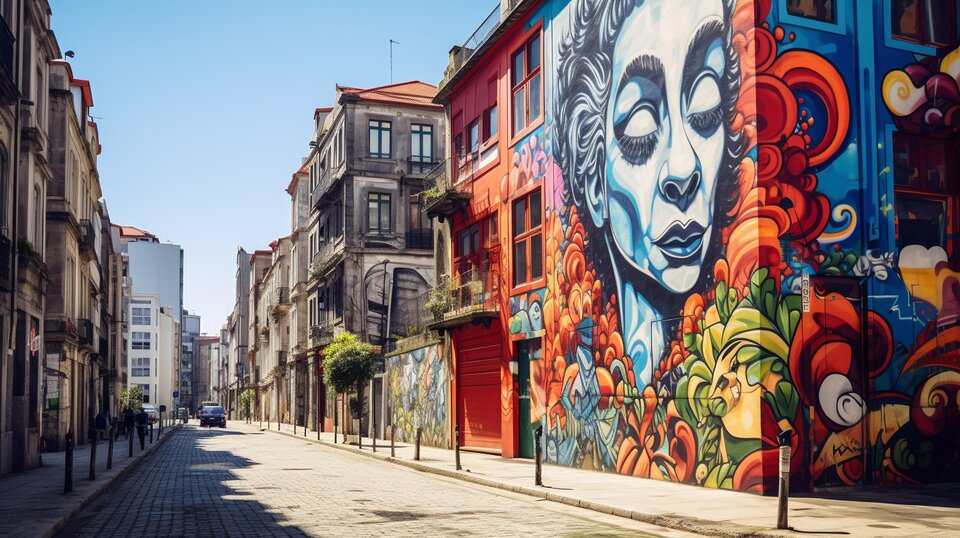
Porto street art is best seen slowly. It is not a clean outdoor museum with everything labelled. It is murals, shutters, alleys, legal pieces, quick tags, political scraps, jokes, names and colour appearing in normal streets.
I like it because it changes. A wall can be there one year and gone the next. A shutter you barely noticed can suddenly become the best part of a walk.
If you want to enjoy it, do not only chase one famous mural. Walk with your eyes open and give the side streets some time.
Where to start
I would start around Cedofeita and Miguel Bombarda. You get galleries, cafés, small shops, side streets and enough walls to make wandering worthwhile.
From there, drift toward Baixa, Trindade, Bonfim or the streets behind the obvious tourist routes. Street art in Porto is scattered, and that is part of the point.
Miguel Bombarda and Cedofeita
This is the easiest art-and-walk area. There are galleries, shopfronts, murals, paste-ups, small details and cafés nearby, so the walk works even if one specific piece has changed or disappeared.
Go during the day, stop for coffee and look at the walls, doors and shutters instead of only looking for big murals.
Pieces change because buildings change, shutters get repainted and artists keep working. Do not expect everything you saw online to still be there.
Baixa and Trindade
Central Porto has pieces tucked between shops, car parks, side streets and older buildings. Some are big and easy to spot. Some are small and quick. Some are not beautiful, and that is fine too.
If you are walking between Clérigos, Aliados, Trindade and Bolhão, keep looking one street away from the main route. The interesting parts are often just outside the most crowded path.
The Mural da Trindade is one of the better-known official examples, with work by Hazul Luzah and Mr. Dheo near the Trindade car park area.
Bonfim
Bonfim has changed a lot, and street art sits inside that change: old workshops, new cafés, residential streets, construction, students, artists and people who lived there before anyone called the area interesting.
Walk respectfully. Do not block doors, photograph into windows or treat residential streets like a private photo set.
Artists to notice
You may see names such as Hazul, Mr. Dheo, Vhils, Bordalo II, Add Fuel, Frederico Draw and other local or Portuguese artists connected with urban art.
I would not turn the walk into a strict artist checklist unless you already know the work. It is better to notice style, placement, humour, scale and how the piece sits in the street.
A simple walking route
- Start near Cedofeita.
- Walk toward Rua de Miguel Bombarda.
- Loop through gallery side streets.
- Head toward Carlos Alberto and the Clérigos edges.
- Continue toward Trindade or Bolhão.
- End in Bonfim if you still have energy.
This route is flexible. Street art moves, and your walk should leave space for that.
When to go
Daylight is best. Morning is quieter, and late afternoon can give better light for photos. Rain makes colours stronger sometimes, but it also makes pavements worse.
Sundays can be quieter for shops and galleries, so check if you want to combine the walk with indoor stops. The walls are still there, but the rest of the day may feel slower.
Photos and respect
- Photograph the art, not random residents.
- Do not block narrow pavements.
- Do not lean on fresh paint.
- Do not block doors or shop entrances.
- Ask before photographing people close up.
- Remember that people live and work around these walls.
Street art and real neighbourhoods
There is a difference between enjoying urban texture and treating old buildings, poverty or decay like decoration. Porto has real housing pressure, renovation, abandoned buildings and people living inside the roughness visitors sometimes photograph.
Enjoy the art, but notice the context too. It makes the walk better, not worse.
Pair it with other stops
- Coffee in Cedofeita.
- Gallery stops around Miguel Bombarda.
- Lunch in Bonfim.
- Clérigos or Carmo area.
- Bolhão Market.
- Bookstores and design shops.
My take
Porto street art is best when you stop treating it like a fixed list and start noticing how the city talks on its walls.
Walk Cedofeita, Miguel Bombarda, Baixa and Bonfim with time. Take photos, spend money locally and leave the neighbourhoods easy for the people who actually live there.