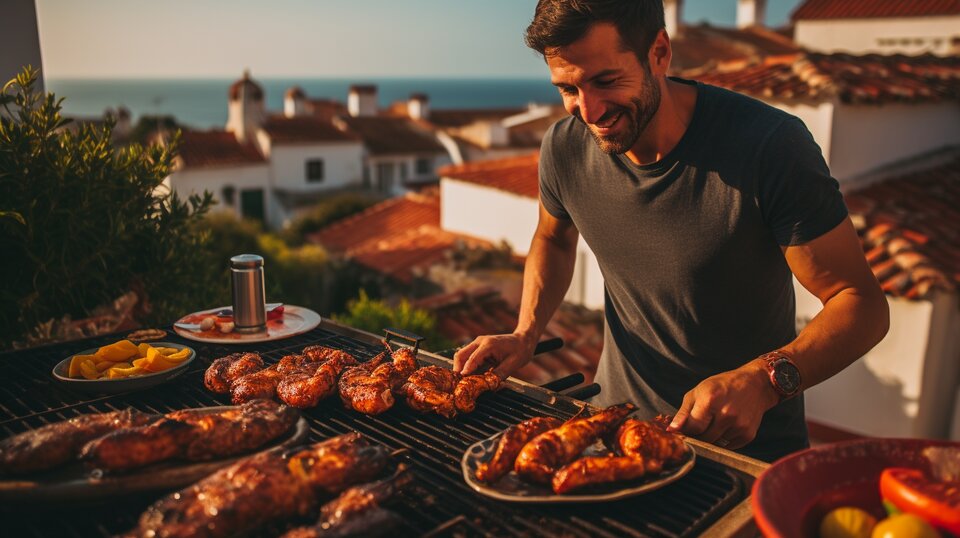
Portugal does outdoor cooking very well. Grilled fish, meat, bread, smoke in the air, people standing around giving opinions. It is part of the good life here.
But fire in Portugal is not something to treat casually, especially outside the city and especially in summer. One small flame in the wrong place, on the wrong day, with wind and dry vegetation, can become serious very fast.
If you are new to Porto or northern Portugal, do not assume that a barbecue, garden fire or bonfire is allowed just because you have seen someone else do it. The rules depend on the place, fire danger, season, municipality, alert status and what kind of fire you mean.
Check the fire danger first
For rural fire danger, check IPMA’s Perigo de Incêndio Rural for the municipality where you are. ANEPC also publishes warnings and preventive measures when risk is high.
If the government declares a Situação de Alerta, those restrictions can override the normal fire-danger rules. So do not only check once at the start of summer and assume it is fine for the rest of the month.
If there is fire spreading, smoke you cannot explain, or a situation that feels unsafe, call 112.
City barbecue and rural fire are not the same thing
A small grill on a city terrace, a barbecue in a Gaia garden, a rural holiday-house barbecue, a bonfire, and burning cut vegetation are not the same situation.
In Porto apartment buildings, the issue may be condominium rules, smoke, neighbours, building safety and common sense. In rural areas, vegetation, wind, drought, access roads and official fire danger matter much more.
The question is not only “can I make fire?” It is “can I make this fire here, today, in this exact place?”
Burning garden waste is not casual
Burning cuttings, branches, brush or agricultural waste is not something I would do without checking first. In Portugal, queimas de amontoados and queimadas extensivas have rules, and they may need prior communication or authorisation.
Use the ICNF queimas e queimadas platform when it applies, and ask your Câmara Municipal, Junta de Freguesia or local civil protection office if you are not sure. Some municipalities have their own procedures, and not every place is handled the same way.
Old local habits are not enough. Someone saying “we always did it this way” does not protect you if the rules, risk level or weather say no.
Barbecues in rural areas
In rural spaces, barbecues and grills can be restricted or prohibited depending on fire danger and whether the place is properly authorised for that use. On very high or maximum danger days, or during alert situations, be especially careful and check official restrictions before lighting anything.
If you are at a picnic park, holiday house or rural rental, do not assume the fixed barbecue area is always usable. Ask the owner or local authority, and check the fire-risk level for that municipality.
Wind should stop the plan
If it is windy, dry or unusually hot, do not make fire outside. That is the simple version.
Even with a barbecue, keep it away from dry vegetation, awnings, fences, stored wood, laundry, plastic furniture and anything else that can catch. Have water nearby. Do not leave it alone. Make sure everything is fully out before leaving.
Balconies and apartment buildings
In Porto apartment buildings, check the condominium rules before using any barbecue on a balcony or terrace. Smoke travels, smells travel, and sparks can become everyone’s problem.
Electric grills may be more acceptable in some buildings, but rules vary. If the balcony is small, windy, or above someone else’s laundry, it is probably not the place for charcoal.
Holiday homes and rural rentals
If you rent a rural house, ask what is allowed before using fire. Ask where the extinguisher is, where the nearest water source is, what the exact address is, and how emergency access works.
It sounds dramatic until something happens and nobody can explain the location properly. In rural Portugal, “the house after the bend near the old road” is not enough information in an emergency.
Bonfires, fireworks and party flames
Bonfires, fireworks, sky lanterns and decorative flames can be restricted, especially during fire-risk periods. Fireworks may need municipal authorisation, and sky lanterns with flames are a bad idea around dry land.
If a party, wedding or village event involves fire, ask the venue, municipality and civil protection rules. If the answer is no, change the plan.
Basic fire sense
- Check IPMA fire danger for the municipality.
- Check ANEPC warnings during hot, dry or windy periods.
- Use the ICNF system or municipality guidance for burning vegetation.
- Do not burn on windy days.
- Do not use fire near dry vegetation.
- Keep water nearby and never leave fire unattended.
- Put everything out completely before leaving.
- Call 112 if fire spreads or you feel unsafe.
My take
Outdoor cooking is one of the nicest parts of life in Portugal, but fire rules are not there to annoy you. They exist because the risk is real.
In the city, respect the building and neighbours. In rural areas, check the official fire danger and local rules before anything with flames. If you are unsure, do not light it.