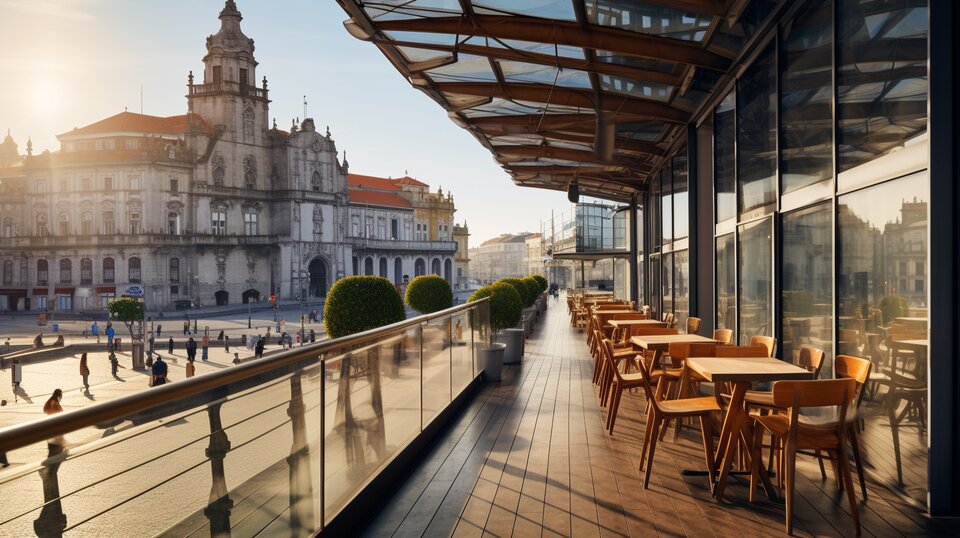
Boavista is not the Porto people usually imagine first. It is wider, busier, more modern and more practical than the old centre. Less river romance, more hotels, offices, clinics, transport, concerts and everyday city life.
I do not go to Boavista when I want tiny streets and old Porto atmosphere. I go there when I need Casa da Música, Avenida da Boavista, appointments, easier access west, or a hotel that is more practical than charming.
That sounds boring, but on some trips boring is exactly what helps.
Where Boavista is
Boavista sits northwest of the historic centre, around Rotunda da Boavista, Casa da Música and Avenida da Boavista. From there the city stretches west toward Serralves, Foz and Matosinhos.
It is not far from the centre, but it feels different. The streets are broader, the traffic is more present and the whole area has more business and residential life than sightseeing mood.
Casa da Música
Casa da Música is the main reason many visitors end up in Boavista. The building was designed by Rem Koolhaas / OMA, opened in 2005, and it is one of Porto’s clearest modern landmarks.
If you like architecture, it is worth seeing even without a concert. If you like music, check the current programme before your trip because the schedule changes all the time. There are also guided visits, which make more sense than only standing outside and guessing what the building is doing.
The area around Casa da Música is not Porto’s prettiest corner, but it is very useful. Metro, buses, taxis, hotels, food and services are all close.
Avenida da Boavista
Avenida da Boavista is one of Porto’s big west-east roads. It runs from the Boavista area toward the coast, passing offices, hotels, schools, shops, restaurants and residential blocks along the way.
I would not treat it as a romantic walking route from end to end. It is long and busy. Use it more like a connection: Boavista to Serralves, Foz, Matosinhos or meetings on the western side of the city.
Hotels in Boavista
Boavista can be a good hotel area if you are in Porto for work, a concert, appointments nearby, or you want a more modern stay away from the old-centre crowds.
The tradeoff is that you are not stepping outside straight into Ribeira, São Bento or the postcard streets. You will use metro, bus, taxi, ride app or longer walks. That is fine if you expected it. It is annoying if you booked only because the room looked cheaper.
Check the exact location. “Boavista” can mean very convenient near Casa da Música, or further west where you may need transport for almost everything.
Offices, clinics and daily life
Boavista is useful for normal life. There are offices, clinics, supermarkets, schools, restaurants, apartment buildings and services. For residents, that can be more important than old stones and pretty photos.
Noise depends a lot on the street. Some blocks feel calm, others feel dominated by traffic. If you are thinking of living there, visit in the morning, at commute time and at night. Also check insulation and damp like you would anywhere in Porto.
Transport
Casa da Música is one of Porto’s important transport points, with metro and bus connections. From Boavista you can reach the centre, connect toward the airport, head to Foz by bus or taxi, or continue toward Matosinhos depending on where you are starting.
It is not difficult, but I still check routes before leaving, especially during works or late at night. A good location in Boavista depends on being close to the transport you actually need, not just close to something on a map.
Food and shopping
Boavista has plenty of practical food: cafes, lunch places, hotel restaurants, business meals and supermarkets. Mercado Bom Sucesso is useful if you want something easy near Casa da Música.
For more character, I would drift toward Cedofeita, Bonfim, Baixa or Foz depending on the mood. Boavista is not bad for food, but it is not the area I choose for slow restaurant wandering.
Who Boavista suits
- Business travellers.
- People going to Casa da Música.
- Visitors who want modern hotels and good transport.
- People with appointments nearby.
- Travellers splitting time between Porto centre, Foz, Matosinhos and the airport.
- Residents who care more about services and access than old-centre atmosphere.
Who should stay elsewhere
- First-time visitors who want classic Porto outside the door.
- People staying only one or two nights for sightseeing.
- Travellers who want nightlife and old-town restaurants nearby.
- Anyone who dislikes traffic and broad roads.
- Visitors who want to walk everywhere without thinking about transport.
My take
Boavista is useful Porto. It gives you Casa da Música, hotels, transport, offices, services and easier access to the western side of the city.
I would stay here when the logistics make sense, especially for work or a concert. For a first romantic trip, I would usually choose somewhere with more old Porto feeling. Boavista is not trying to be charming all the time, and honestly that is part of why it works.