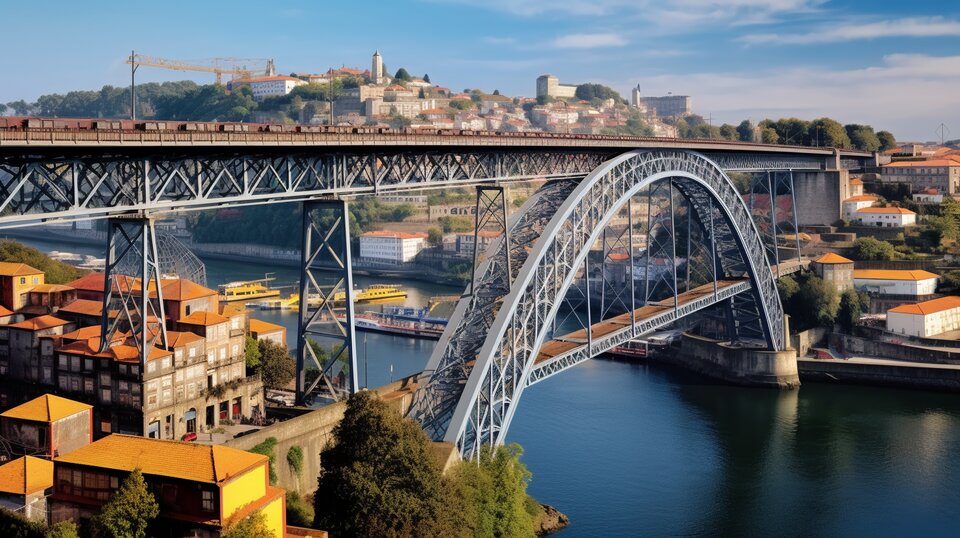
Dom Luís I Bridge is not just a lookout. It is the everyday crossing between Porto and Vila Nova de Gaia, with two decks and two very different walks. If you only cross once, go over the upper deck for the view and come back down at river level.
Upper deck: the high route
The upper deck links the cathedral side of Porto with Jardim do Morro in Gaia. It is shared by pedestrians and Metro do Porto, so keep to the marked footway and step aside before stopping for a photo. The view opens over Ribeira, the river and the cellars on the south bank. Upper-deck map
From Porto, you can start near Sé; in Gaia, start at Jardim do Morro. The approaches are steep. If the hill is the problem, use the metro rather than making the bridge crossing the hardest part of the day.
Lower deck: quay to quay
The lower deck is the direct connection between Ribeira and Gaia’s waterfront by the port lodges. Pedestrians share the crossing with public transport, taxis and bicycles, so it is useful but not a quiet promenade. Use the pedestrian space and be alert at the approaches. Gaia riverfront map
A route I like
Start by São Bento and walk up to Sé, cross the upper deck to Jardim do Morro, then continue to the Serra do Pilar terrace if your legs are happy. Descend to Gaia’s waterfront for lunch or a cellar booking, and return to Ribeira over the lower deck. That gives you the high view and the river-level crossing without climbing back up the same hill.
If you want the sunset, arrive before the light turns golden; the upper deck and Jardim do Morro fill up. Morning is easier for photos and for moving at your own pace. In rain or strong wind, the exposed upper route is less pleasant, and wet paving makes the approaches slippery.
A little history
The metal bridge was built between 1881 and 1886 to a design by Théophile Seyrig, a former partner of Gustave Eiffel. It opened on 31 October 1886 and is part of the UNESCO-listed Historic Centre of Porto and the Monastery of Serra do Pilar. Infraestruturas de Portugal’s bridge history has the dates and structure; UNESCO’s listing explains the wider heritage area.
It is worth crossing, even when it is busy. Just remember it is a working bridge: stay aware of the metro, do not stop in the flow, and keep children close on both decks.